 Add to Chrome
 Add to Firefox
 Add to Edge
Imagine a City: CityGenAgent for Procedural 3D City Generation
Feb 05, 2026
The automated generation of interactive 3D cities is a critical challenge with broad applications in autonomous driving, virtual reality, and embodied intelligence. While recent advances in generative models and procedural techniques have improved the realism of city generation, existing methods often struggle with high-fidelity asset creation, controllability, and manipulation. In this work, we introduce CityGenAgent, a natural language-driven framework for hierarchical procedural generation of high-quality 3D cities. Our approach decomposes city generation into two interpretable components, Block Program and Building Program. To ensure structural correctness and semantic alignment, we adopt a two-stage learning strategy: (1) Supervised Fine-Tuning (SFT). We train BlockGen and BuildingGen to generate valid programs that adhere to schema constraints, including non-self-intersecting polygons and complete fields; (2) Reinforcement Learning (RL). We design Spatial Alignment Reward to enhance spatial reasoning ability and Visual Consistency Reward to bridge the gap between textual descriptions and the visual modality. Benefiting from the programs and the models' generalization, CityGenAgent supports natural language editing and manipulation. Comprehensive evaluations demonstrate superior semantic alignment, visual quality, and controllability compared to existing methods, establishing a robust foundation for scalable 3D city generation.

Failing on Bias Mitigation: Investigating Why Predictive Models Struggle with Government Data
Jan 21, 2026The potential for bias and unfairness in AI-supporting government services raises ethical and legal concerns. Using crime rate prediction with the Bristol City Council data as a case study, we examine how these issues persist. Rather than auditing real-world deployed systems, our goal is to understand why widely adopted bias mitigation techniques often fail when applied to government data. Our findings reveal that bias mitigation approaches applied to government data are not always effective -- not because of flaws in model architecture or metric selection, but due to the inherent properties of the data itself. Through comparing a set of comprehensive models and fairness methods, our experiments consistently show that the mitigation efforts cannot overcome the embedded unfairness in the data -- further reinforcing that the origin of bias lies in the structure and history of government datasets. We then explore the reasons for the mitigation failures in predictive models on government data and highlight the potential sources of unfairness posed by data distribution shifts, the accumulation of historical bias, and delays in data release. We also discover the limitations of the blind spots in fairness analysis and bias mitigation methods when only targeting a single sensitive feature through a set of intersectional fairness experiments. Although this study is limited to one city, the findings are highly suggestive, which can contribute to an early warning that biases in government data may persist even with standard mitigation methods.
AutoMonitor-Bench: Evaluating the Reliability of LLM-Based Misbehavior Monitor
Jan 09, 2026We introduce AutoMonitor-Bench, the first benchmark designed to systematically evaluate the reliability of LLM-based misbehavior monitors across diverse tasks and failure modes. AutoMonitor-Bench consists of 3,010 carefully annotated test samples spanning question answering, code generation, and reasoning, with paired misbehavior and benign instances. We evaluate monitors using two complementary metrics: Miss Rate (MR) and False Alarm Rate (FAR), capturing failures to detect misbehavior and oversensitivity to benign behavior, respectively. Evaluating 12 proprietary and 10 open-source LLMs, we observe substantial variability in monitoring performance and a consistent trade-off between MR and FAR, revealing an inherent safety-utility tension. To further explore the limits of monitor reliability, we construct a large-scale training corpus of 153,581 samples and fine-tune Qwen3-4B-Instruction to investigate whether training on known, relatively easy-to-construct misbehavior datasets improves monitoring performance on unseen and more implicit misbehaviors. Our results highlight the challenges of reliable, scalable misbehavior monitoring and motivate future work on task-aware designing and training strategies for LLM-based monitors.
MONICA: Real-Time Monitoring and Calibration of Chain-of-Thought Sycophancy in Large Reasoning Models
Nov 09, 2025Large Reasoning Models (LRMs) suffer from sycophantic behavior, where models tend to agree with users' incorrect beliefs and follow misinformation rather than maintain independent reasoning. This behavior undermines model reliability and poses societal risks. Mitigating LRM sycophancy requires monitoring how this sycophancy emerges during the reasoning trajectory; however, current methods mainly focus on judging based on final answers and correcting them, without understanding how sycophancy develops during reasoning processes. To address this limitation, we propose MONICA, a novel Monitor-guided Calibration framework that monitors and mitigates sycophancy during model inference at the level of reasoning steps, without requiring the model to finish generating its complete answer. MONICA integrates a sycophantic monitor that provides real-time monitoring of sycophantic drift scores during response generation with a calibrator that dynamically suppresses sycophantic behavior when scores exceed predefined thresholds. Extensive experiments across 12 datasets and 3 LRMs demonstrate that our method effectively reduces sycophantic behavior in both intermediate reasoning steps and final answers, yielding robust performance improvements.
Fine-Grained Interpretation of Political Opinions in Large Language Models
Jun 05, 2025Studies of LLMs' political opinions mainly rely on evaluations of their open-ended responses. Recent work indicates that there is a misalignment between LLMs' responses and their internal intentions. This motivates us to probe LLMs' internal mechanisms and help uncover their internal political states. Additionally, we found that the analysis of LLMs' political opinions often relies on single-axis concepts, which can lead to concept confounds. In this work, we extend the single-axis to multi-dimensions and apply interpretable representation engineering techniques for more transparent LLM political concept learning. Specifically, we designed a four-dimensional political learning framework and constructed a corresponding dataset for fine-grained political concept vector learning. These vectors can be used to detect and intervene in LLM internals. Experiments are conducted on eight open-source LLMs with three representation engineering techniques. Results show these vectors can disentangle political concept confounds. Detection tasks validate the semantic meaning of the vectors and show good generalization and robustness in OOD settings. Intervention Experiments show these vectors can intervene in LLMs to generate responses with different political leanings.
Mitigating Degree Bias Adaptively with Hard-to-Learn Nodes in Graph Contrastive Learning
Jun 05, 2025Graph Neural Networks (GNNs) often suffer from degree bias in node classification tasks, where prediction performance varies across nodes with different degrees. Several approaches, which adopt Graph Contrastive Learning (GCL), have been proposed to mitigate this bias. However, the limited number of positive pairs and the equal weighting of all positives and negatives in GCL still lead to low-degree nodes acquiring insufficient and noisy information. This paper proposes the Hardness Adaptive Reweighted (HAR) contrastive loss to mitigate degree bias. It adds more positive pairs by leveraging node labels and adaptively weights positive and negative pairs based on their learning hardness. In addition, we develop an experimental framework named SHARP to extend HAR to a broader range of scenarios. Both our theoretical analysis and experiments validate the effectiveness of SHARP. The experimental results across four datasets show that SHARP achieves better performance against baselines at both global and degree levels.
HypoBench: Towards Systematic and Principled Benchmarking for Hypothesis Generation
Apr 15, 2025There is growing interest in hypothesis generation with large language models (LLMs). However, fundamental questions remain: what makes a good hypothesis, and how can we systematically evaluate methods for hypothesis generation? To address this, we introduce HypoBench, a novel benchmark designed to evaluate LLMs and hypothesis generation methods across multiple aspects, including practical utility, generalizability, and hypothesis discovery rate. HypoBench includes 7 real-world tasks and 5 synthetic tasks with 194 distinct datasets. We evaluate four state-of-the-art LLMs combined with six existing hypothesis-generation methods. Overall, our results suggest that existing methods are capable of discovering valid and novel patterns in the data. However, the results from synthetic datasets indicate that there is still significant room for improvement, as current hypothesis generation methods do not fully uncover all relevant or meaningful patterns. Specifically, in synthetic settings, as task difficulty increases, performance significantly drops, with best models and methods only recovering 38.8% of the ground-truth hypotheses. These findings highlight challenges in hypothesis generation and demonstrate that HypoBench serves as a valuable resource for improving AI systems designed to assist scientific discovery.
Holistic Capability Preservation: Towards Compact Yet Comprehensive Reasoning Models
Apr 09, 2025This technical report presents Ring-Lite-Distill, a lightweight reasoning model derived from our open-source Mixture-of-Experts (MoE) Large Language Models (LLMs) Ling-Lite. This study demonstrates that through meticulous high-quality data curation and ingenious training paradigms, the compact MoE model Ling-Lite can be further trained to achieve exceptional reasoning capabilities, while maintaining its parameter-efficient architecture with only 2.75 billion activated parameters, establishing an efficient lightweight reasoning architecture. In particular, in constructing this model, we have not merely focused on enhancing advanced reasoning capabilities, exemplified by high-difficulty mathematical problem solving, but rather aimed to develop a reasoning model with more comprehensive competency coverage. Our approach ensures coverage across reasoning tasks of varying difficulty levels while preserving generic capabilities, such as instruction following, tool use, and knowledge retention. We show that, Ring-Lite-Distill's reasoning ability reaches a level comparable to DeepSeek-R1-Distill-Qwen-7B, while its general capabilities significantly surpass those of DeepSeek-R1-Distill-Qwen-7B. The models are accessible at https://huggingface.co/inclusionAI
Beyond Prior Limits: Addressing Distribution Misalignment in Particle Filtering
Jan 30, 2025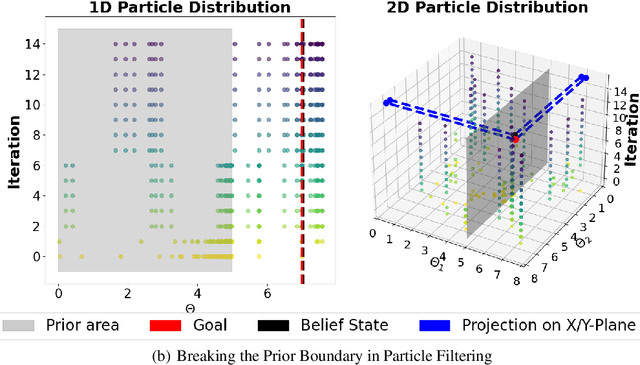
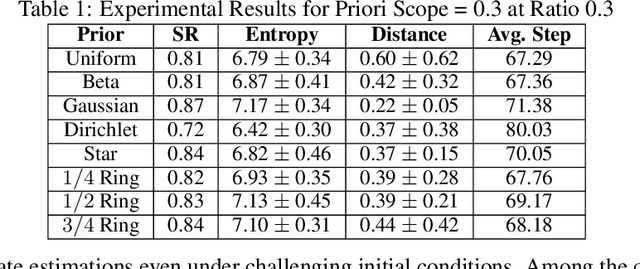
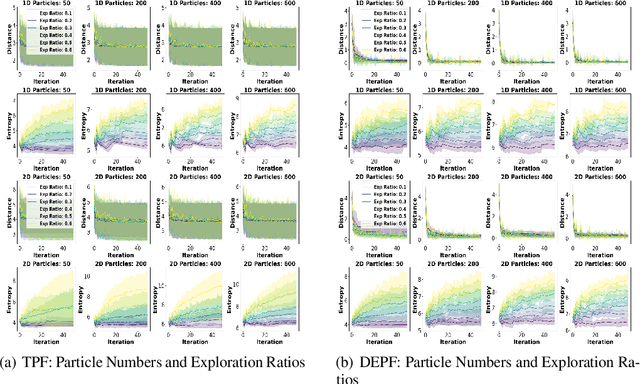
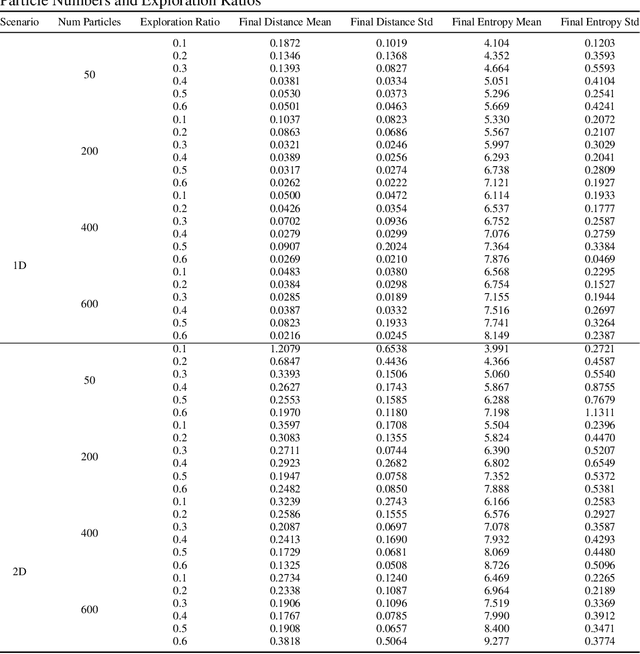
Particle filtering is a Bayesian inference method and a fundamental tool in state estimation for dynamic systems, but its effectiveness is often limited by the constraints of the initial prior distribution, a phenomenon we define as the Prior Boundary Phenomenon. This challenge arises when target states lie outside the prior's support, rendering traditional particle filtering methods inadequate for accurate estimation. Although techniques like unbounded priors and larger particle sets have been proposed, they remain computationally prohibitive and lack adaptability in dynamic scenarios. To systematically overcome these limitations, we propose the Diffusion-Enhanced Particle Filtering Framework, which introduces three key innovations: adaptive diffusion through exploratory particles, entropy-driven regularisation to prevent weight collapse, and kernel-based perturbations for dynamic support expansion. These mechanisms collectively enable particle filtering to explore beyond prior boundaries, ensuring robust state estimation for out-of-boundary targets. Theoretical analysis and extensive experiments validate framework's effectiveness, indicating significant improvements in success rates and estimation accuracy across high-dimensional and non-convex scenarios.
Large Vision-Language Model Alignment and Misalignment: A Survey Through the Lens of Explainability
Jan 02, 2025Large Vision-Language Models (LVLMs) have demonstrated remarkable capabilities in processing both visual and textual information. However, the critical challenge of alignment between visual and linguistic representations is not fully understood. This survey presents a comprehensive examination of alignment and misalignment in LVLMs through an explainability lens. We first examine the fundamentals of alignment, exploring its representational and behavioral aspects, training methodologies, and theoretical foundations. We then analyze misalignment phenomena across three semantic levels: object, attribute, and relational misalignment. Our investigation reveals that misalignment emerges from challenges at multiple levels: the data level, the model level, and the inference level. We provide a comprehensive review of existing mitigation strategies, categorizing them into parameter-frozen and parameter-tuning approaches. Finally, we outline promising future research directions, emphasizing the need for standardized evaluation protocols and in-depth explainability studies.